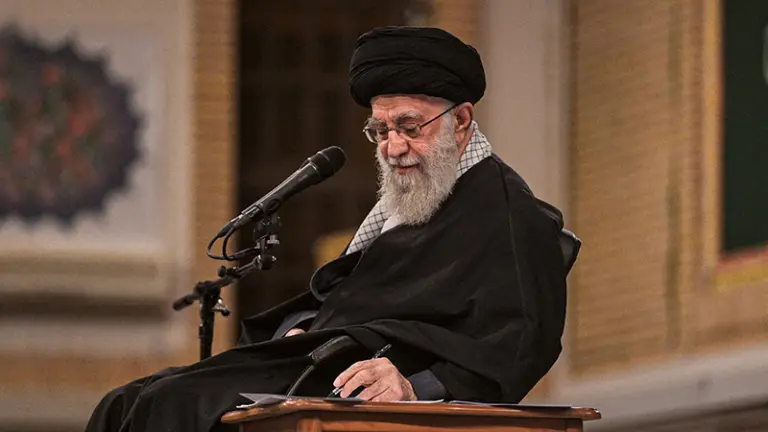
In September 2000, I found myself in the mausoleum of the former supreme leader of the Islamic Republic, Ayatollah Ruhollah Khomeini, outside Tehran. Joined by scholars from Europe and the United States, I sat in the front row, yards from the podium where his successor as Supreme Leader, Ali Khamenei, was about to speak. When Khamenei arrived, his loyal supporters shouted the usual slogans, but the episode seemed anticlimactic. Khamenei could not match the charisma of his firebrand predecessor, whose stern face peered out from the massive posters festooning the walls of the huge shrine. Yet if Khomeini founded the Islamic Republic of Iran, it was Khamenei who built it. After he became supreme leader in 1989, Khamenei bound together what had been a loose array of state institutions and governing committees, making them inseparable from the regime and thereby ensuring that the system would outlive him.
The test of Khamenei’s success came on February 28, 2026, when a joint Israel-US strike destroyed the Office of the Supreme Leadership Authority, Khamenei’s official residence and office, killing him and many of his close advisors and family members. When CIA operatives learned of plans for the gathering, they reportedly informed Israel, which then launched an attack in broad daylight. Despite the risk of an imminent threat from the United States and Israel, Khamenei had apparently refused to take shelter in a bunker, insisting that he would stay at his desk. He was prepared to die, expected death, and perhaps even sought it. At 86, having suffered from prostate cancer for years, Khamenei had made detailed plans to be followed after his death.
Expect the Unexpected
Iran’s new leadership is currently reading from the script left by Khamenei. US President Donald Trump initially called for regime change in Iran as a goal of the US-Israel campaign (though his administration soon walked that back), yet he might still strike a deal with Tehran. On March 1, 2026, Trump claimed that “they want to talk, and I have agreed to talk,” which seemed to point in the direction of diplomacy, but two days later stated that it is “too late” for talk and that the United States and Israel would sustain their attacks for four weeks or longer. Given Trump’s mercurial nature and the rapidly changing geopolitical situation, we should expect the unexpected. A weakened and isolated Iranian regime that might be able to crush its internal opponents but cannot menace the wider region might be one outcome that could allow all parties—the United States, Israel, and even Iran—to declare victory. The alternative to such a face-saving solution could be prolonged war, an economic and political nightmare that could cost Trump on the domestic front.
Regime-State Survival Above All Else
Khamenei’s greatest achievement was binding all forms of power in Iran—political, economic, religious, ideological, military, institutional, and security—to the state. While never fully realized, this fusion strategy was sufficiently robust to ensure that the fate of key powerholders was intertwined with the regime’s survival. This rule of unity applies first and foremost to the Islamic Revolutionary Guard Corps, but it also applies to other groups, among them religious clerics, whom Khamenei ensured were loyal to him and his office. A vast network of banks, businesses, and security forces—buttressed by a web of family marriages and alliances with Khamenei at its center—suffered a huge blow with his death. Now, regime cadres invested in the system Khamenei built must either reconstruct it or face the consequences. For them, it is do or die.
The succession process after Khamenei was always going to be fraught.
The “do” strategy does not exclusively depend on selecting a new supreme leader. The succession process after Khamenei was always going to be fraught, as the Leader alone has the constitutional authority to shape or reshape the Islamic Republic’s key institutions and its guiding ideology. Still, it now appears that Mojtaba Khamenei will succeed his father. His appointment suggests that Iran’s leaders are prioritizing a strategy of revenge. It is an extraordinary and risky decision that underscores a desperate regime’s determination to do whatever it takes to survive.
Assuming Mojtaba is indeed the new Supreme Leader, one thing is clear: He will work closely with Ali Larijani. A former commander of the IRGC, speaker of parliament, and secretary of the Supreme National Security Council (SNSC) since 2005, Ali Larijani’s most important credential is the personal relationship he forged with Khamenei. After the June 2025 12-day war with Israel and the United States, Larijani emerged as a key player in the regime when he was appointed as SNSC chief.
Larijani is a ruthless if pragmatic ideologue. Devoted to the Revolution, in January 2026, he again proved his mettle by presiding over the violent repression of the Iranian protest movement. Larijani has stated that “Iran, unlike the United States, has prepared itself for a long war.” He promised that Iran will “fiercely defend ourselves…regardless of the costs and will make the enemies sorry for their miscalculation.” Mojtaba Khamenei most certainly agrees with him.
Iran Plays for Time
Larijani should be taken at his word. For him and his allies, the best bet is to draw the United States into a protracted war. While Iran is targeting the US presence in the Gulf, its focus is hitting energy facilities there. Iran has effectively closed the Strait of Hormuz, sending world gas prices soaring and causing stock markets to stutter. Qatar, which produces 20 percent of the world’s liquified natural gas, has suspended production after a March 2, 2026, Iranian drone attack. Such attacks are likely to increase.
Escalation carries risks for Iran. While it may have had as many as 2,500 heavy ballistic missiles at the start of the war, that number will quickly be depleted. The United States faces a similar problem. Its supply of Tomahawk missiles, Patriot anti-missile systems, and other interceptors, such as THAAD, is also running out. If Qatar and the United Arab Emirates start running out of interceptors, their leaders will pressure Trump to end the war. Iran’s strategy is therefore to increase the pressure on the United States by dragging out the war. Iran has one major political advantage: it does not have to worry about domestic public opinion. Indeed, Larijani and his allies will crush any hint of rebellion or protest, especially in Tehran, the seat of political and economic power. They can do so knowing that as oil prices rise, Trump’s base could sour on a war he had promised to avoid and for which he has no exit strategy. Each side hopes that it can outlast its adversary. Iran’s leaders are wagering that Trump will be the first to flinch.
Trump’s Baffling Signals
On March 2, 2026, three days into the war, Trump said, “I don’t have the yips with respect to boots on the ground—like every president says, ‘There will be no boots on the ground.’ I don’t say it.” Secretary of Defense Pete Hegseth echoed this statement, insisting that “President Trump ensures our enemies understand we’ll go as far as we need to go to advance American interests. But we’re not dumb about it…you don’t have to roll 200,000 people in there and stay for 20 years.” It is hard to know if Hegseth was suggesting that the United States might get by with only a few thousand soldiers in Iran for just a few months. But such statements not only show how nervous the administration is; they also illustrate the absence of any coherent strategy linking the means to clear and feasible ends.
No one should underestimate the critical role that Trump’s emotions play in shaping his foreign policy decisions.
It is possible that this strategic gap is a product of the process (or lack thereof) by which Trump ultimately chose to go to war. Israeli Prime Minister Benjamin Netanyahu reportedly played a decisive role in convincing Trump to launch a war to destroy Iran’s ballistic missile system and topple the regime. Yet it is also likely that the prospect of “decapitating” Iran’s leadership and “freeing” the Iranian people appealed to Trump’s vanity and the magical thinking that accompanies it. No one should underestimate the critical role that Trump’s emotions play in shaping his foreign policy decisions, day-to-day and even hour-to-hour. This point was underscored by a report that Trump saw the assassination of Khamenei as payback for an Iranian plot to kill him during the 2024 presidential campaign. As he put it, “They tried twice. Well, I got him first.”
There is no doubt that the United States will continue assassinating Iranian leaders in the belief that this strategy will deliver a political silver bullet to the regime. But rather than opening a path to democratic transition, more such killings could ignite more internal conflict and accelerate national fragmentation in Iran. A different outcome is also possible: a protracted stalemate between a US president searching for an exit strategy and a battered yet resilient regime unwilling to capitulate. In that case, absent a settlement that allows both sides to claim some measure of victory, the conflict could slide into open-ended war —the very scenario that Trump once insisted he would avoid. Seeking vengeance for his father’s death, Mojtaba Khamenei will certainly embrace any strategy that will cost the US money, and especially blood.
The views expressed in this publication are the author’s own and do not necessarily reflect the position of the Arab Center, Washington DC, its staff, or its Board of Directors.